
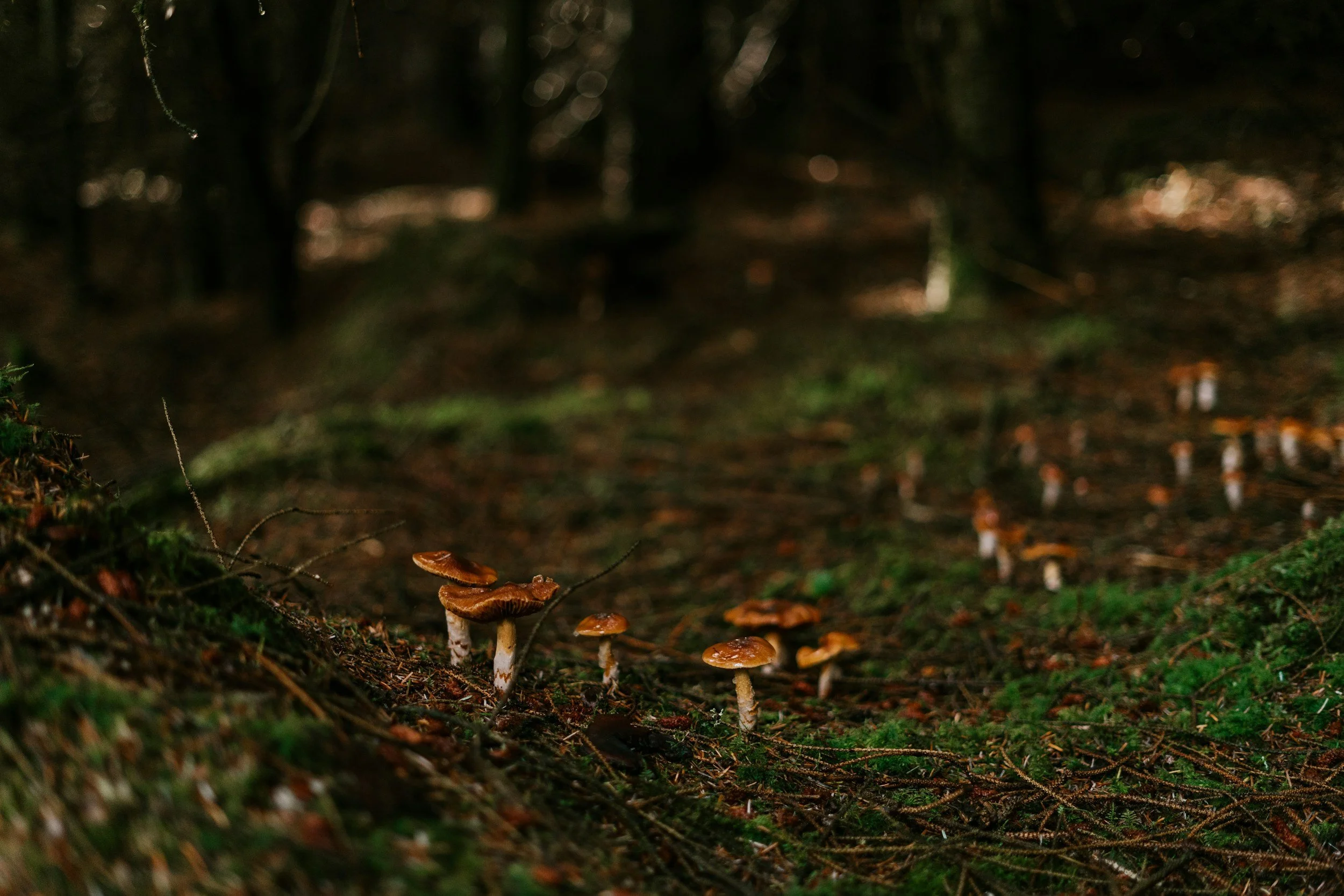
Restoring Ancient Woodland
Our woodland is at the heart of what we do. Much of it was planted with commercial conifers, including larch, Scots pine and Douglas fir, but areas of ancient woodland still survive amongst the plantation. Our long-term restoration plan is to gradually bring the woodland back to a diverse, predominantly native ecosystem — protecting the ancient woodland that remains, encouraging natural regeneration and carefully replacing plantation trees with native species such as oak, hazel, birch, rowan and holly.
Alongside this restoration, we're creating coppice, wildlife-rich rides and glades, wetland habitat, food-producing trees and shrubs, and areas where fungi can flourish. Timber removed as part of the restoration is put to good use wherever possible, including through our biochar production. In this way, the work we do in the woodland helps support its recovery — building a healthier, more diverse and resilient woodland for generations to come.
Scroll Down To See Our Full Woodland Restoration Plan

Sweethill Eco Fort
Woodland Restoration Working Plan
1. Purpose and long-term vision
The aim is to restore the surviving ancient woodland, progressively convert the existing larch, Douglas fir and plantation structure into a resilient, predominantly native broadleaf woodland, and retain a productive working woodland that supports Sweethill Biochar to continue its sustainability and soil regeneration work, as well as promoting education and community engagement.
The restored site should combine conservation, timber and coppice production, food production, water resilience, tree propagation, education and low-impact woodland enterprise. The productive woodland helps finance and physically support the restoration of the less intensively managed ancient woodland.
The guiding principle is restoration rather than wholesale replacement: protecting ancient woodland remnants first, favouring natural regeneration where it is working, selectively thinning plantation trees, and using enrichment planting where the desired native woodland is not returning by itself.
-
. Site summary
Total woodland: approximately 15 acres (c. 6.1 ha).
Elevation: between 120-180 m above sea level.
Existing canopy: predominantly larch, Scots pine and Douglas fir plantation, with surviving ancient woodland areas/remnants.
Landform: the woodland occupies a spur, with steep slopes on the east, south and west sides. Approximately 8 acres consist of flatter ground across the top and northern parts of the site. There are underground springs on the east and west banks.
Existing working infrastructure:
Large plant storage shed
Biochar-making station
2x temporary log stores
Moveable woodland welfare unit
Moveable office
Moveable storage
Tapped spring (east side)
Desired additions:
Native tree nursery
Solar timber kilns and biochar drying area
Permanent log store
Water reservoir/wildlife lakes
Managed coppice
Food-producing trees and shrubs
Dedicated fungi-growing area
3. Proposed woodland zones
The intention is to create a mosaic of interconnected habitats rather than rigid blocks in accordance with biomimicry.
A. Ancient woodland restoration — approximately 3–5 acres*
Protect surviving ancient woodland features and restore plantation-on-ancient-woodland areas.
Management should be relatively low intervention, with gradual conifer reduction, protection of natural regeneration, retention of deadwood and restoration of native woodland structure.
B. Native woodland conversion — approximately 4–6 acres*
Gradually convert plantation to diverse native woodland through selective thinning, natural regeneration and enrichment planting.
C. Coppice — approximately 1–1.5 acres
Create a productive rotational coppice for poles, stakes, craftwood, fuel, mushroom logs and wildlife habitat.
D. Food woodland / forest-garden edge — approximately 0.5–1 acre
Establish fruit trees, nut trees and edible shrubs within sunny glades and woodland edges.
E. Working woodland hub — approximately 1–2 acres
Accommodate the existing biochar operation, shed, timber/log storage, welfare facilities and proposed solar kilns.
F. Native tree nursery — approximately 0.25–0.75 acre
Grow trees and shrubs for the woodland restoration programme, ideally including material propagated from appropriate local native trees.
G. Water and open-habitat network — approximately 0.5–1 acre
Reservoir/wildlife lake, wet woodland, glades, scrub, rides and open habitat.
H. Fungi-growing corner
A smaller, shaded productive area associated particularly with the coppice and food woodland, providing dedicated space for cultivated edible mushrooms while keeping introduced fungi separate from the ancient woodland restoration areas.
4. Ancient woodland and PAWS restoration
The ancient woodland areas are the highest ecological priority.
Before substantial forestry work begins we are:
Mapping and protect surviving native trees.
Identifing old coppice stools.
Identifing veteran and future-veteran trees.
Protecting woodbanks, ditches and historic boundaries.
Recording old tracks.
Identifing significant deadwood.
Surveying ancient woodland ground flora.
Identifying naturally regenerating native trees.
Recording important fungi and fungal habitats where possible.
We will avoid blanket clear-felling within sensitive ancient woodland areas.
Instead, we will use gradual, targeted thinning to reduce plantation conifers without abruptly exposing the woodland floor.
We prioritise existing oak, hazel, holly, birch, rowan and other native regeneration when selecting trees for retention.
We are retaining substantial amounts of standing and fallen deadwood where it is safe to do so.
We will control regenerating non-native plantation species where they threaten native regeneration.
We will use enrichment planting primarily where natural regeneration is absent or insufficiently diverse.
5. Native woodland species framework
Final species selection should respond to soil, drainage, exposure and the composition of nearby semi-natural woodland.
Main canopy
Sessile oak
Pedunculate oak
Silver birch
Downy birch
Selected retained Scots pine
(The relative proportions of sessile and pedunculate oak should ultimately reflect soil conditions and the species occurring naturally in nearby old woodland.)
Secondary trees and understorey
Hazel
Holly
Rowan
Crab apple
Wild cherry
Woodland edges and scrub
Hawthorn
Blackthorn
Hazel
Holly
Elder
Dog rose
Guelder rose
European spindle (Euonymus europaeus)
Wetter ground
Alder
Downy birch
Goat willow
Grey willow
Pedunculate oak where appropriate
6. Coppice plan
Create a dedicated coppice of approximately 1–1.5 acres on suitable accessible ground outside the most sensitive ancient woodland areas.
Historic coppice stools discovered within the ancient woodland should are being assessed for restoration.
Principal coppice species
Hazel would form the backbone of the coppice.
It can produce:
Biochar
Bean poles
Pea sticks
Stakes
Hurdle material
Craft material
Kindling
Mushroom-growing logs
Hazel nuts
Wildlife habitat
Willow could be incorporated into wetter areas.
A limited number of oak standards will be retained above the coppice to produce a traditional coppice-with-standards structure.
We will divide the coppice into approximately 7–10 small coupes.
One coupe could then be cut each winter, creating a continually changing habitat:
freshly cut coppice → young shoots → dense young coppice → mature coppice → cutting again
This also provides a regular supply of appropriately sized woody material for woodland products and mushroom cultivation.
7. Food trees, nuts and edible shrubs
Food production will primarily occupy sunny woodland edges, glades and the productive area surrounding the nursery rather than being introduced into sensitive ancient woodland.
The objective is to create a productive woodland edge or loose forest-garden system.
Larger fruit and nut trees
Potential species include:
Apple, particularly Devon/local heritage varieties
Pear
Plum
Damson
Sweet chestnut where appropriate
Walnut
Smaller fruit/nut trees
Crab apple
Cherry
Medlar
Quince
Hazel/cob
Edible shrubs
Blackcurrant
Redcurrant
Gooseberry
Raspberry
Blackberry selections
Elder
Native food and wildlife species
Hazel
Hawthorn
Blackthorn
Crab apple
Elder
Wild strawberry
open productive area → fruit/nut trees → berry bushes → fungi area → hazel coppice → native scrub → native woodland → ancient woodland
8. Fungi and mushroom management
Fungi is an explicit part of the woodland restoration strategy.
There are two different objectives.
A. Restoring wild woodland fungi
Across the ancient and native woodland areas, encourage naturally occurring fungi through habitat creation rather than introducing commercial species.
This includes:
Retaining fallen trunks
Retaining large branches
Leaving some standing deadwood where safe
Leaving old stumps
Maintaining deep leaf litter
Creating shaded deadwood piles
Minimising unnecessary disturbance to woodland soils
Avoiding excessive machinery movement
Maintaining humid woodland conditions
Encouraging diverse native tree species and ages
These measures should help support decomposer fungi and the mycorrhizal fungi associated with living woodland trees.
Mushroom spawn will not be deliberately introduced into the ancient woodland restoration areas.
B. Dedicated fungi-growing corner
A separate productive fungi area will be created close to the coppice and food woodland.
This should be relatively shaded, sheltered and humid but still easily accessible.
It could contain:
Inoculated hardwood mushroom logs
Mushroom log stacks
Partially buried logs
Standing inoculated stumps where suitable
Woodchip mushroom beds
Shaded propagation areas
Suitable material arising from coppicing and woodland management will become a productive resource rather than waste.
Over time, the fungi corner could become an attractive and educational feature as well.
9. Working woodland hub
We will keep the existing and proposed working infrastructure as compact as possible.
This should include:
Shed
Biochar station
Log storage
Timber processing
Welfare unit
Solar kilns
Associated vehicle access
We will design timber flow so material moves efficiently:
woodland extraction → sorting → useful timber → solar kiln/storage → firewood/coppice products/biochar/mushroom logs
We will retain an appropriate fire-safe working clearing around the biochar station.
Solar kilns will be positioned according to actual year-round solar exposure, taking account of surrounding woodland and the hills to the east, south and west.
10. Native tree nursery
We will create a small nursery close to the working area and proposed reservoir.
It should be:
Easily accessible
Sunny enough for propagation
Close to water
Protected from deer and rabbits
Convenient enough to receive regular attention
The nursery could propagate:
Oak
Hazel
Rowan
Hawthorn
Holly
European spindle
Crab apple
Other appropriate native trees and shrubs
Where possible and appropriate, we will collect seed from healthy trees within the local landscape.
The nursery will supplement rather than replace natural regeneration.
11. Reservoir / wildlife lake and wet woodland
The reservoir should perform several functions:
Nursery irrigation
Water resilience
Potential firefighting reserve for woodland/biochar operations
Wildlife habitat
Landscape feature
Creation of wet woodland habitat
Its precise position will follow the site's actual contours, drainage and hydrology.
Rather than creating a purely utilitarian rectangular reservoir, we will create an irregular naturalistic design incorporating:
Deeper water-storage zone
Shallow shelves
Gently sloping margins
Sunny open-water margins
Wetland vegetation
Willow scrub
Alder/wet woodland
The ecological transition will become:
open water → marginal plants → willow → alder → birch/oak woodland
12. Rides, glades and open habitat
The objective is not to cover every available acre with closed-canopy woodland.
We will maintain an interconnected network of:
Woodland rides
Glades
Coppice coupes
Reservoir margins
Scrub
Food-producing clearings
Fungi areas
Woodland edge
Where possible, we will use existing extraction routes rather than disturbing additional woodland.
We will allow rides periodically to widen into sunny glades and scalloped woodland edges.
13. Circular woodland economy
One of the central ideas behind the plan is that conservation and productive woodland management should support each other.
The cycle becomes:
Plantation restoration
↓
Timber and woody material
↓
Useful construction timber / solar kiln
Coppice products
Firewood
Mushroom logs
Biochar feedstock↓
Biochar + nursery + water
↓
Native tree propagation and woodland restoration
↓
Future native woodland, coppice, food, fungi and wildlife
The productive woodland therefore helps finance and physically support the restoration of the less intensively managed ancient woodland.
14. Indicative 20-year programme
Year 1
Map woodland compartments.
Verify ancient woodland/PAWS boundaries.
Survey trees, flora and significant fungal habitats.
Assess soils, drainage and hydrology.
Map infrastructure and access.
Identify future coppice, food, fungi, nursery and reservoir areas.
Years 1–3
Begin first targeted plantation thinning.
Protect natural regeneration.
Establish tree nursery.
Establish first coppice coupes.
Create fungi-growing corner.
Improve principal rides.
Begin producing mushroom logs from appropriate management material.
Plan reservoir.
Years 2–5
Construct reservoir/wetland if appropriate and approved.
Establish food woodland.
Begin formal coppice rotation.
Plant gaps where natural regeneration is insufficient.
Develop solar kiln area.
Expand fungi production.
Years 5–10
Second-stage plantation thinning.
Allow extensive native regeneration.
Continue coppice rotation.
Manage fruit/nut trees.
Monitor fungal diversity and deadwood.
Manage browsing and competing vegetation.
Years 10–15
Continue selective conifer removal.
Recruit future veteran trees.
Increase structural diversity.
Continue food, coppice and mushroom production.
Years 15–20+
Move increasingly toward continuous-cover native woodland management.
Maintain cyclical coppice.
Harvest fruit/nuts.
Maintain fungi production.
Continue nursery propagation.
Retain and increase deadwood.
Monitor ancient woodland recovery.
15. First-year working checklist
Confirm Ancient Woodland Inventory/PAWS boundaries.
Divide the woodland into numbered management compartments.
Map significant native trees.
Map veteran/future-veteran trees.
Identify historic coppice stools.
Map woodbanks, ditches and old tracks.
Carry out a spring/early-summer ground-flora survey.
Undertake a baseline fungi survey if possible.
Assess soil, drainage and exposure.
Assess deer, rabbit and grey-squirrel pressure.
Mark approximately 1–1.5 acres for coppice.
Divide coppice into future rotational coupes.
Identify sunny ground for food trees and shrubs.
Identify a sheltered/shaded fungi-growing corner.
Select the nursery site.
Survey solar exposure for the solar kilns.
Investigate hydrology and permissions for the reservoir.
Prepare a formal woodland management plan.
Confirm felling-licence and other regulatory requirements before substantial work begins.
16. Monitoring
Every 2–3 years, we will record:
Native/non-native canopy proportions
Native natural regeneration
Tree species diversity
Ancient woodland flora
Browsing damage
Squirrel damage
Deadwood quantity and diversity
Veteran-tree recruitment
Coppice regrowth
Coppice yields
Fruit/nut production
Nursery production
Tree establishment rates
Reservoir/wetland condition
Wild fungi observed
Mushroom production
Timber outputs
Biochar feedstock arising from restoration work
Over time, this should give us a record not simply of how many trees have been planted, but of whether the woodland ecosystem itself is recovering.