
Biochar for Tree Planting
Give newly planted trees a better start — and invest in the soil for the long term
For professional tree planting, successful establishment is everything.
Whether you're delivering a landscape scheme, planting specimen trees, establishing an orchard, creating woodland or undertaking large-scale environmental planting, the real measure of success isn't how the trees look on completion day.
It's how well they establish in the years that follow.
Newly planted trees face a significant transition. Their roots need to move beyond the rootball or existing root system and establish into unfamiliar soil while coping with fluctuations in moisture, temperature and nutrient availability.
Biochar can be incorporated at planting to help create a more resilient root-zone environment.
Its highly porous carbon structure can influence water and nutrient retention, provide surfaces and pore spaces for soil microorganisms and remain within the soil for a very long time.
For professional tree-planting businesses, the opportunity is straightforward:
You're already working with the root zone. This is the ideal time to improve it.
Once the tree is established, you may never have such easy access to that soil again.
Why Use Biochar in Professional Tree Planting?
Support Successful Establishment
The period immediately following planting is critical.
A newly planted tree initially depends upon a relatively restricted root system. Until new roots establish into the surrounding soil, its ability to access water and nutrients is limited.
Biochar isn't a rooting hormone and it doesn't guarantee successful establishment.
What it can do is become part of the soil environment into which those new roots are growing.
When appropriately incorporated around the rootball and within the rooting zone, charged biochar interacts with water, nutrients, organic compounds and soil biology.
And unlike many organic amendments, biochar is highly resistant to decomposition.
For a tree expected to occupy a site for decades, that persistence is particularly relevant.
Put Biochar Where New Roots Will Find It
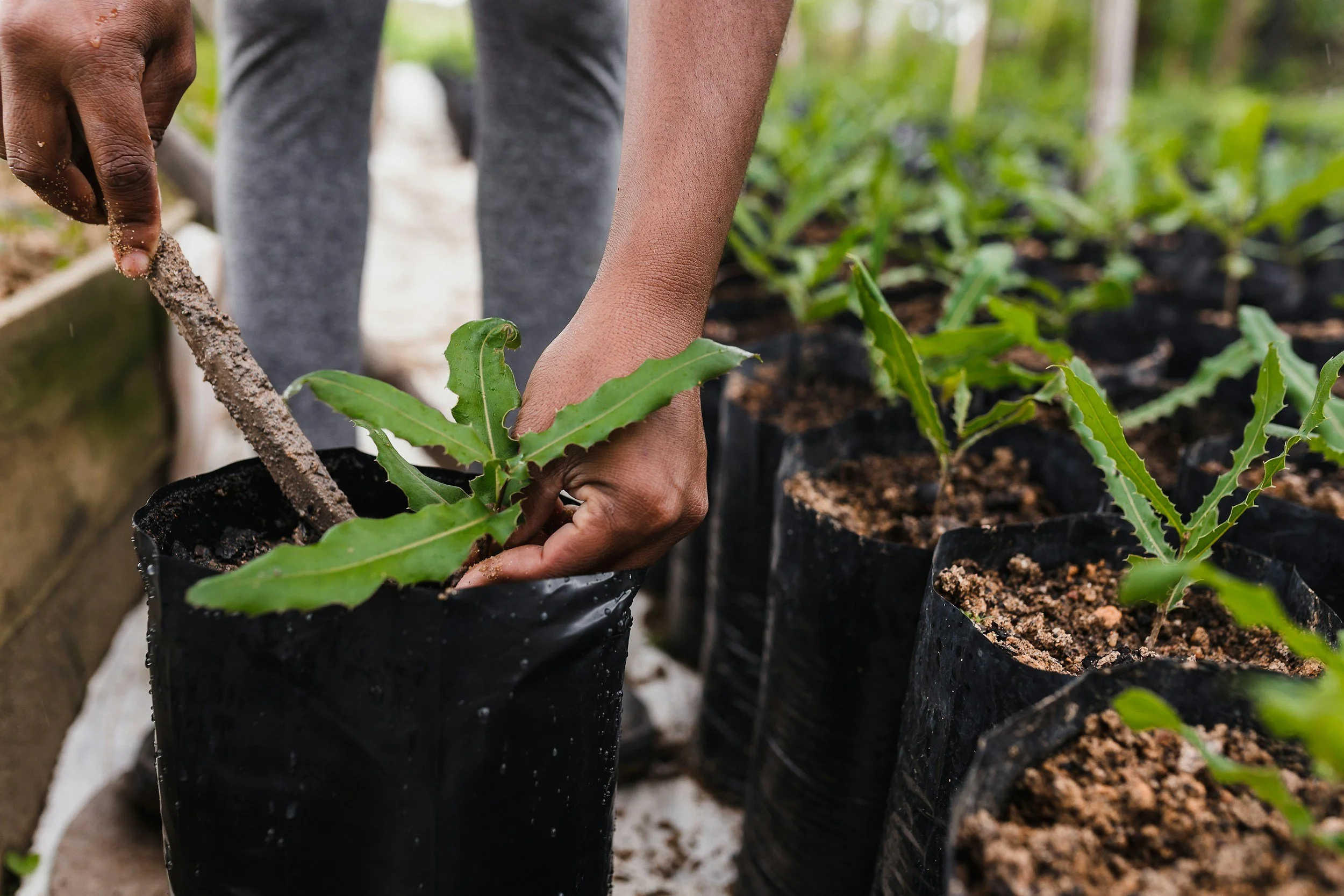
For individual tree planting, one of the most practical ways to use biochar is to place thoroughly charged biochar around and immediately adjacent to the rootball during backfilling.
This puts the biochar directly within the zone into which new roots will initially grow.
As the tree establishes, roots extend through the biochar-enriched area and into the surrounding soil. Root growth, soil organisms, earthworms, water movement and normal soil processes can also gradually help integrate and redistribute the biochar within the wider root zone.
For contractors, targeted application can be particularly useful because a relatively modest quantity of biochar can be concentrated where it is most immediately relevant to establishment, rather than requiring a large volume of surrounding soil to be treated.
Depending on the planting specification, charged biochar can be:
applied directly around the rootball,
mixed with soil immediately surrounding the rootball,
combined with suitable compost or planting material,
or distributed more widely through the prepared rooting zone.
The appropriate approach will depend on the tree, site and planting specification.
The principle is simple:
Put charged biochar where developing roots are going to encounter it.
Water Management
Help the root zone make better use of available water
Water is one of the biggest challenges in professional tree establishment.
Newly planted trees can require substantial watering during their first few growing seasons, particularly during prolonged dry weather.
That has implications for:
labour,
water consumption,
bowsers and vehicles,
site visits,
maintenance contracts,
and ultimately tree survival.
Biochar contains an extensive network of pores capable of interacting with water within the soil.
Depending upon soil type, biochar characteristics and application rate, incorporating biochar can influence the water-holding properties of the root zone. This may be particularly relevant on lighter, free-draining soils.
Biochar does not mean newly planted trees no longer need establishment watering.
They do.
Correct watering remains one of the most important parts of successful tree establishment.
Instead, biochar can form part of creating soil that makes better use of the rainfall and irrigation it receives.
For professional contractors, that's worth investigating.
Could Biochar Help Reduce Tree Losses?
This is potentially one of the most commercially important questions for a tree-planting business.
A failed tree is expensive.
There's the original tree, but potentially also:
removal,
replacement stock,
transport,
labour,
machinery,
stakes and ties,
watering,
administration,
and another visit to site.
There may also be contractual replacement obligations and reputational costs.
If improving the root-zone environment contributes to better establishment under particular site conditions, even a relatively modest reduction in losses could have significant commercial value.
But we think this should be tested rather than simply claimed.
Trial it. Record it. Compare it.
Use biochar on part of an appropriate planting project and retain comparable trees planted according to your usual specification.
Monitor survival and establishment over subsequent seasons.
If biochar-treated trees perform better within your particular planting system, you then have something far more useful than a generic claim about biochar:
your own evidence.
Nutrient Retention
Biochar isn't a conventional fertiliser.
Instead, its extensive internal and external surfaces can interact with nutrients within the soil.
As biochar ages, changes to its surface chemistry can also increase its ability to retain and exchange certain nutrient ions.
This means biochar can complement existing soil fertility, compost and other appropriate amendments rather than simply providing a short-lived nutrient boost at planting.
A useful shorthand is:
Compost feeds. Biochar helps hold.
The actual soil chemistry is more complex, but it provides a useful way of understanding the complementary roles of the two materials.
For a tree that may remain in position for decades, improving the soil's long-term capacity to manage water and nutrients can be particularly valuable.
Supporting the Living Root Zone
A healthy tree doesn't exist independently of its soil.
Around its roots is a complex biological environment containing fungi, bacteria and many other organisms involved in nutrient cycling and decomposition.
Biochar's intricate pore structure creates a large amount of internal and external surface area.
Those surfaces can interact with moisture, nutrients, organic compounds and microorganisms, while some pores can provide protected microhabitats for soil life.
Biochar doesn't automatically create healthy soil biology.
That depends on the wider environment and management system.
But it can become part of the long-term physical habitat within which that biology operates.
Always Charge Biochar Before Planting
For professional tree-planting applications, we recommend thoroughly wetting and charging Sweethill Biochar before use.
Don't apply our biochar dry.
Fresh biochar has an extensive pore network and large available surface area. Pre-conditioning allows moisture, nutrients and organic compounds to begin interacting with those surfaces before the material reaches the root zone.
Wetting also significantly reduces dust during handling — an important practical consideration when larger quantities are being used on site.
Depending on the planting specification, biochar can be charged using appropriate materials such as:
compost
compost extracts
suitable liquid nutrient solutions
well-rotted organic materials
other appropriate nutrient-containing materials.
For larger projects, charging could potentially be incorporated into soil or compost preparation before material reaches the individual planting position.
A Simple Targeted Application Method
For many professional tree-planting operations, biochar application can be straightforward.
1. Wet and charge the biochar
Make sure the biochar is thoroughly wetted and appropriately conditioned before application.
2. Prepare the planting position
Prepare the site and tree according to normal professional arboricultural practice.
3. Position the tree correctly
Ensure the tree is at the appropriate planting depth, with particular attention to the root flare.
4. Apply charged biochar around the rootball
As the tree is backfilled, distribute charged biochar around the sides of the rootball.
It can be used directly or mixed with the surrounding soil, compost or other appropriate planting material.
5. Backfill normally
Continue backfilling so that the biochar becomes part of the immediate rooting environment rather than remaining in one isolated pocket.
6. Complete the planting operation
Stake, mulch and protect the tree where required.
7. Water thoroughly
Follow the appropriate establishment-watering programme for the tree and site.
This creates a biochar-enriched transition zone between the existing rootball and the surrounding soil — exactly where new roots need to establish.
Can Biochar Go Beneath the Rootball?
Yes — biochar can be incorporated into soil immediately around the rootball, including beneath it.
What matters is how it's used.
We wouldn't recommend creating a thick, loose layer of pure biochar underneath a tree.
That could create an unnecessary interface between the rootball and the supporting soil.
Instead, charged biochar can be mixed through appropriate soil beneath and around the rootball while maintaining correct planting depth and adequate physical support.
So the useful distinction is:
Charged biochar within the soil around the rootball: yes. A thick isolated layer of loose biochar beneath it: no.
The aim is to create a biochar-enriched rooting environment, not an underground layer of biochar.
Targeted Application Can Make Commercial Sense
There is another advantage to applying biochar around individual rootballs.
It can make professional application much more practical.
Rather than amending large quantities of soil across an entire site, contractors can apply a measured quantity to each planting position.
That can mean:
less material required
straightforward application
easier costing per tree
consistent instructions for planting teams
less additional soil handling
biochar concentrated within the immediate establishment zone.
Once a business has trialled the product, it could develop standard application specifications for different categories of planting.
For example:
whips and transplants
feathered trees
standards
heavy standards
semi-mature and specimen trees
could each have an appropriate application quantity and method.
This also makes it much easier to price biochar as an enhanced tree-establishment option within client quotations and planting specifications.
Biochar Doesn't Replace Good Arboricultural Practice
No soil amendment can compensate for fundamentally poor tree planting.
Biochar should complement established professional practice.
Correct attention still needs to be given to:
planting depth and root-flare position
root condition
planting-hole preparation
soil compaction
drainage
available rooting volume
staking and support where necessary
mulching
protection from damage
establishment watering
appropriate species selection.
If a site is severely compacted, address the compaction.
If it is waterlogged, investigate the drainage.
If the rooting volume is inadequate, biochar won't make it adequate.
Biochar should enhance good tree planting — not compensate for bad tree planting.
Biochar for Urban Tree Planting
Urban tree establishment can be particularly challenging.
Trees may need to cope with:
restricted rooting volumes,
compacted soils,
high temperatures,
hard surfaces,
limited rainfall infiltration,
and irregular water availability.
Biochar may therefore be particularly interesting for street trees, commercial developments, housing schemes, public-realm planting and other urban landscape projects.
Targeted application around the rootball may offer a relatively simple way of introducing biochar during conventional planting.
Where engineered tree soils, structural soils or specialist tree-pit systems are being used, however, biochar should be considered as part of the overall specification.
Changing the composition of an engineered growing medium can alter water movement, air-filled porosity, pH, nutrient behaviour and structural performance.
For substantial projects, biochar should therefore be properly specified and, where appropriate, trialled.
Biochar for Large-Scale Tree Planting
The application method that makes sense for a specimen tree may make no sense when planting thousands of woodland whips.
For woodland creation, shelterbelts, hedging, rewilding and environmental planting, application needs to be:
quick, repeatable and economically justifiable.
Targeted application around each plant may still be possible, particularly if the biochar can be incorporated into an existing mechanised or manual planting process.
Alternatively, biochar might be prioritised for:
free-draining areas,
drought-prone sites,
higher-value planting,
known establishment problem areas,
or controlled trial plots.
Biochar should have a defined purpose within the planting specification.
We don't advocate applying it simply because trees are being planted.
Biochar for Orchards & Agroforestry
Orchards and agroforestry projects offer another interesting application because decisions made during establishment can influence a productive system for decades.
Charged biochar can be applied directly around the rootball during planting or incorporated more widely into the surrounding rooting area.
For commercial projects, consider establishing treated and untreated rows or blocks.
Then monitor:
establishment and mortality,
annual growth,
soil moisture,
irrigation requirement,
tree health,
and eventually yield and crop quality.
Because biochar persists, multi-year observations are particularly valuable.
Biochar and Carbon-Conscious Tree Planting
There is an unusually complementary relationship between biochar and tree planting.
Trees capture atmospheric carbon dioxide as they grow and incorporate carbon into their biomass.
Through pyrolysis, a proportion of the carbon captured by previous plant growth can be converted into a much more stable form.
When biochar is incorporated into the soil, much of that carbon can remain stored there for a very long time.
A tree-planting project can therefore potentially do two things simultaneously:
Establish new trees that will capture carbon as they grow.
Incorporate stable carbon from previous tree growth into the soil beneath them.
We wouldn't describe an entire planting project as "carbon negative" simply because it uses biochar. Tree production, transport, machinery, materials and maintenance all have associated emissions.
But incorporating responsibly produced biochar provides a real mechanism for putting stable carbon into the landscape.
Something Meaningful to Offer Your Clients
For professional tree-planting businesses, biochar can also add another dimension to an environmental planting specification.
Clients increasingly want to understand what makes a project genuinely sustainable.
Biochar gives contractors something tangible to explain:
We've incorporated locally produced biochar around the root zone of your trees. It places stable carbon into the landscape while becoming part of the soil environment in which the trees will establish.
That's more meaningful than simply describing a project as "green".
And with Sweethill Biochar, you can tell clients exactly where that biochar came from.
Why Choose Sweethill Biochar?
Traceable biochar produced by us in Devon
If you're specifying biochar partly for environmental reasons, it makes sense to ask about the environmental story of the biochar itself.
Where did the biomass come from?
Why was it harvested?
Who produced the biochar?
How traceable is the supply chain?
Sweethill Biochar is produced by us in Devon using timber arising from the management of our own woodland.
Much of our woodland is ancient woodland that was historically planted with commercial conifers.
We're gradually removing those plantation trees as part of our long-term work to restore a more diverse native woodland ecosystem.
Some of that timber becomes our biochar.
That means:
We know where our feedstock grew.
We know why those trees were removed.
We know what goes into our kilns.
We produce the biochar ourselves.
And we're directly involved in restoring the woodland from which it originated.
We're not simply purchasing anonymous biochar and repackaging it.
For professional tree-planting businesses making environmental commitments to their own clients, that traceability matters.
From One Generation of Trees to the Next
There's a particularly appropriate circularity to using our biochar for tree planting.
A plantation tree is removed as part of restoring an ancient woodland.
Some of that timber is transformed through pyrolysis.
A proportion of its carbon becomes stable biochar.
That biochar is placed into the rooting environment of another tree.
New roots grow through it.
The tree establishes and grows.
The carbon remains within the soil.
And purchasing the biochar helps us continue restoring the woodland where the process began.
Carbon captured by one generation of trees, stored in the soil beneath the next.
Trial Biochar on Your Next Tree-Planting Project
For professional tree planting, we don't think biochar should be specified simply because it sounds sustainable.
It should have a purpose.
Perhaps you're looking to improve establishment on free-draining soils.
Perhaps irrigation is a significant cost.
Perhaps replacement rates are a problem on a particular type of site.
Perhaps a client wants stable carbon incorporated into their landscape.
Or perhaps you're developing a more environmentally responsible standard tree-planting specification.
Whatever the objective, define it first.
Then trial biochar against your normal planting method and monitor the results.
Look at:
tree survival,
establishment,
new growth,
soil moisture,
watering requirements,
and longer-term performance.
That's how biochar moves from being an interesting environmental product to becoming a useful professional tree-establishment tool.
Trade & Bulk Biochar for Tree-Planting Businesses
Sweethill Biochar is available for professional tree-planting contractors, arboricultural businesses, landscapers, estates, orchards, agroforestry projects, woodland creation and larger environmental planting schemes.
We can work with businesses wanting to trial biochar, establish repeatable application methods or incorporate it into a wider planting specification.
And because targeted application around the rootball can be straightforward, biochar doesn't necessarily need to complicate the planting operation.
Charge it. Put it where the new roots will grow. Let the tree do the rest.