
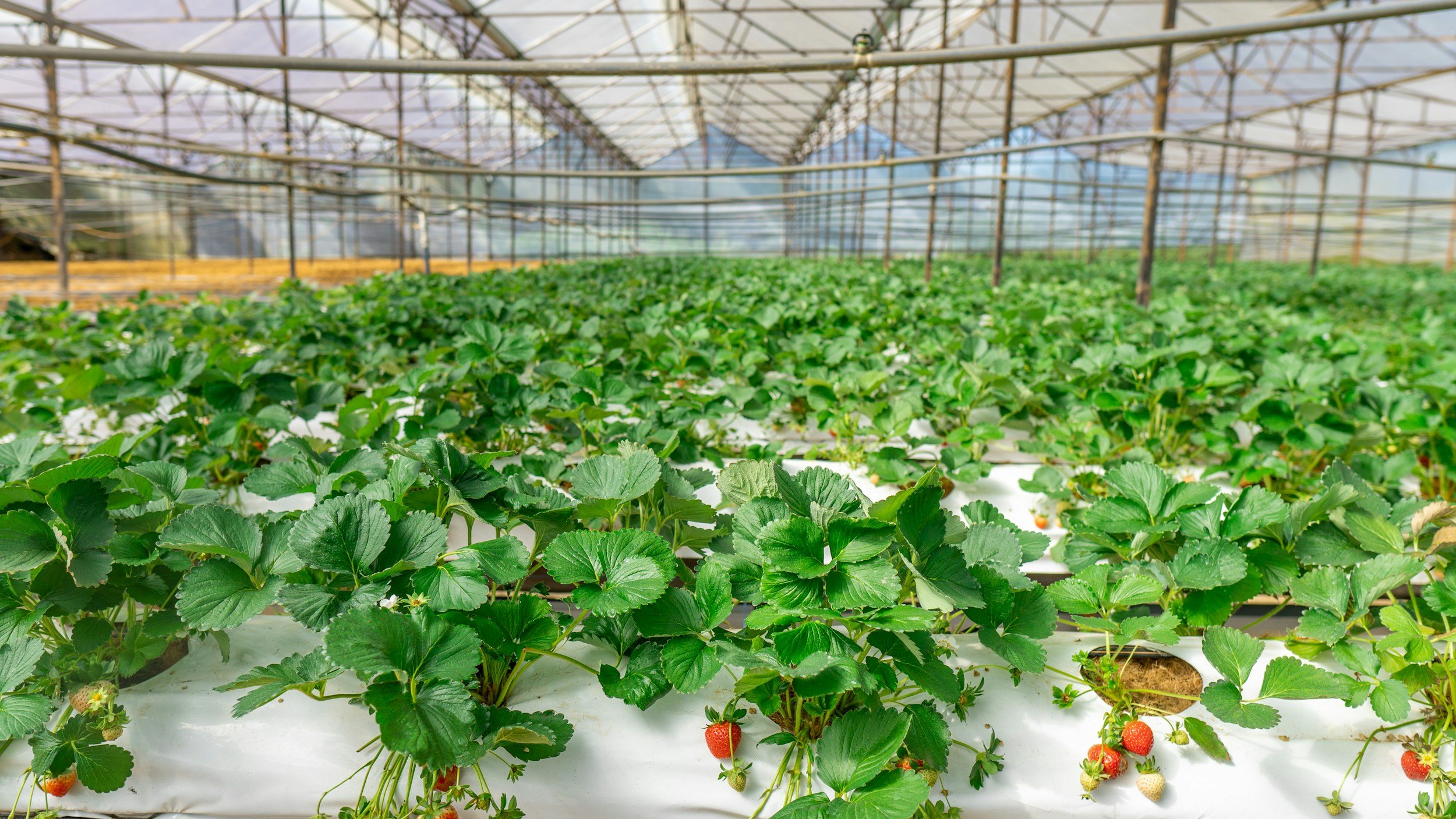
Biochar for Hydroponics
Exploring biochar as part of soilless growing systems
At first glance, biochar and hydroponics might seem like an unusual combination.
Biochar is most often associated with soil improvement. Hydroponics, by definition, moves plant production away from conventional soil and supplies water and nutrients directly to the root zone.
But many hydroponic and soilless systems still need something important:
a physical environment around the roots.
That's where biochar becomes interesting.
Biochar is lightweight, highly porous and has an extensive internal surface area. Depending on its properties and how it is prepared, it has potential as a component of soilless substrates, where it can interact with water, nutrients, roots and microorganisms.
For commercial growers, this is still an area where careful testing matters. Biochar should not simply be poured into an established hydroponic system on the assumption that it will improve it.
Instead, we see it as a material worth controlled trials within suitable substrate-based growing systems.
Where Does Biochar Fit Into Hydroponics?
It's important to distinguish between different types of hydroponic production.
Some systems grow plants with their roots directly in nutrient solution, while others use substrates such as coir, perlite, rockwool or other materials to physically support the root system while water and nutrients are delivered through irrigation.
Biochar is generally much easier to investigate in the second category.
Potential applications include:
Substrate-based drip systems
where biochar is incorporated as one component of the growing medium.
Dutch/Bato bucket systems
where plants grow within containers filled with substrate.
Soilless container production
where nutrient solution is supplied through irrigation.
Research and experimental growing media
where growers are investigating alternatives to conventional substrate components.
Aquaponic and biologically active systems
where the interaction between porous materials and microorganisms may be of particular interest.
For systems such as NFT or deep-water culture, where roots are directly exposed to circulating nutrient solution, loose biochar requires much more caution. Fine particles entering pumps, pipework, emitters or filters could create practical problems.
Biochar is therefore not a universal hydroponic additive.
The system matters.
Why Is Biochar Interesting for Soilless Growing?
An Extraordinary Pore Structure
Biochar might look like a simple black granule, but under magnification it contains an intricate network of pores inherited partly from the cellular structure of the original wood.
Those pores create a very large internal surface area.
Within a growing substrate, that means biochar can interact with:
water,
dissolved nutrients,
organic compounds,
microorganisms,
and plant roots.
For a hydroponic grower accustomed to thinking carefully about what happens within the root zone, those characteristics are worth investigating.
Water-Holding Capacity
One of the jobs performed by a soilless substrate is managing the balance between water and air.
Roots need moisture.
But they also need oxygen.
A substrate that drains too rapidly may require very frequent irrigation, while one that retains excessive water can reduce root-zone aeration.
Biochar can influence the water-holding properties of a growing medium.
However, the effect depends strongly on factors including:
particle size,
pore structure,
the other substrate components,
biochar inclusion rate,
and the particular biochar being used.
This is why biochar shouldn't simply be treated as a generic replacement for coir, perlite or another established substrate.
The useful question is:
How does this particular biochar change the physical properties of my existing substrate?
For commercial hydroponics, that's something to measure rather than assume.
Nutrient Retention
This is perhaps one of the most interesting potential applications.
Hydroponic growers spend considerable effort controlling nutrient availability.
Biochar has reactive surfaces capable of interacting with dissolved nutrient ions.
Depending upon the biochar and surrounding conditions, it can adsorb and exchange various nutrients.
In a substrate-based system, this creates the possibility that biochar could act as part of a nutrient-buffering environment within the root zone.
But there's an important qualification.
In hydroponics, nutrient concentration is deliberately controlled.
Anything that changes how those nutrients behave can potentially affect the balance you're trying to maintain.
So nutrient retention isn't automatically beneficial.
If fresh biochar initially adsorbs nutrients from your solution, for example, it could alter nutrient availability.
This is one reason pre-conditioning biochar becomes particularly important for hydroponic trials.
Charging Biochar for Hydroponic Use
For our normal soil applications, we recommend charging Sweethill Biochar before use.
For hydroponics, we'd go further:
Biochar should be thoroughly pre-conditioned before entering a production system.
Don't introduce dry Sweethill Biochar directly into a hydroponic substrate.
Dry biochar can contain fine particles, can initially be difficult to wet uniformly and hasn't yet equilibrated with your nutrient environment.
For a hydroponic trial, a logical approach is to condition the biochar using an appropriately formulated nutrient solution compatible with the crop you're growing.
Thoroughly wet the material and allow it to soak.
The objective is to begin saturating the pore structure and allow the surfaces to interact with the nutrient solution before plants depend upon that environment.
For commercial systems, we'd recommend a longer and more controlled conditioning process than the simple two-hour minimum we suggest to home gardeners.
The appropriate method should be developed alongside your existing nutrient-management protocol.
Wash and Grade Before Trialling
Particle size becomes particularly important in hydroponics.
Fine biochar particles may be perfectly acceptable in soil.
Inside an irrigation system, they may not be.
Before trialling biochar commercially, growers should consider whether the material needs to be:
graded,
screened,
thoroughly wetted,
and potentially rinsed to remove excessive fines.
This is especially important where irrigation water is recirculated.
You don't want small carbon particles migrating from the substrate into:
pumps,
emitters,
filters,
reservoirs,
or pipework.
The physical specification of the biochar therefore matters just as much as its chemistry.
Biochar as a Substrate Component
We'd recommend initially investigating biochar as one component of a proven growing medium, rather than trying to grow commercially in pure biochar.
For example, a grower already using coir might investigate whether replacing a small proportion of the existing substrate with appropriately graded and conditioned biochar changes root-zone performance.
A simple trial might compare:
Control: 100% existing substrate
Trial A: existing substrate + 5% biochar by volume
Trial B: existing substrate + 10% biochar by volume
The other components would be adjusted so total substrate volume remains consistent.
These aren't universal recipes.
They're simply useful starting points for experimentation.
Why Not Start With 100% Biochar?
Because commercial growing isn't about finding the most dramatic experiment.
It's about consistency.
Pure biochar could have very different physical and chemical characteristics from the substrate your irrigation and nutrition programme was designed around.
Changing to 100% biochar could substantially alter:
water retention,
air-filled porosity,
pH,
electrical conductivity,
nutrient behaviour,
and irrigation requirements.
A controlled partial-substitution trial tells you far more about whether biochar actually adds value to your existing system.
Monitor pH
This is particularly important.
Biochars can vary substantially in pH, and many wood-derived biochars are alkaline.
Hydroponic production relies on relatively precise management of root-zone pH because pH affects nutrient availability.
Introducing biochar without measuring its effect could therefore alter the chemistry of your growing system.
Commercial trials should monitor:
Feed-solution pH and root-zone pH.
Don't assume that because biochar performs well in soil, it can be added to a hydroponic substrate without changing anything else.
Monitor Electrical Conductivity
EC is another obvious measurement.
Hydroponic growers use electrical conductivity as an important indicator of dissolved nutrient concentration.
Because biochar can interact with dissolved ions, growers trialling it should monitor EC carefully.
Compare the control substrate with the biochar-containing substrate.
Watch what happens after irrigation.
Watch what happens over time.
And monitor the plant.
The objective is to understand whether biochar stabilises, disrupts or has little meaningful effect on your existing nutrient-management system.
Biochar and Root-Zone Microbiology
Hydroponics isn't necessarily biologically sterile.
Many modern soilless growing systems deliberately incorporate beneficial microorganisms and biological root-zone management.
Biochar's pore structure is interesting in this context because it provides an enormous amount of surface area on which microbial communities can potentially establish.
This could make biochar particularly interesting for:
biologically managed hydroponics,
aquaponics,
organic soilless systems,
and other approaches where root-zone microbiology forms part of crop management.
However, this shouldn't be translated into a simplistic claim that "biochar adds beneficial microbes".
It doesn't necessarily.
Rather:
Biochar provides potential habitat.
What colonises that habitat depends upon the biological environment into which it's introduced.
Biochar and Aquaponics
Aquaponics is an especially interesting area for biochar research because plants, nutrients, microorganisms and water are already deliberately integrated within one biological system.
Biochar's surface area and pore structure make it potentially interesting as a substrate or microbial habitat within appropriately designed systems.
However, aquaponics is also a carefully balanced ecosystem.
Any material introduced into it needs to be considered in terms of:
pH,
water chemistry,
nutrient availability,
particle release,
microbial activity,
fish health,
and system filtration.
We therefore wouldn't recommend simply adding general-purpose biochar to an operating aquaponic system.
It should be appropriately characterised and trialled first.
Could Biochar Reduce Reliance on Other Substrate Materials?
This is one of the bigger questions.
Commercial soilless horticulture relies on significant quantities of growing-media materials.
Some have substantial environmental footprints associated with extraction, manufacturing or transport.
Locally produced biochar therefore raises an interesting possibility:
Could a proportion of conventional substrate material be replaced with a locally produced, renewable-carbon-derived material that also stores stable carbon?
The answer isn't automatically yes.
The replacement still has to perform horticulturally.
It needs appropriate particle size.
It needs consistency.
It needs suitable chemistry.
It needs to work with existing irrigation systems.
And it needs to make commercial sense.
But it's precisely the kind of question we think is worth investigating.
The Carbon Question
Biochar has another characteristic that makes it unusual among potential substrate components.
It's a form of stable carbon.
Trees remove carbon dioxide from the atmosphere as they grow and incorporate some of that carbon into wood.
Through pyrolysis, a proportion of that biomass carbon can be converted into a much more persistent form.
If biochar is incorporated into a growing system and ultimately returned to soil, that carbon can potentially remain stored for a very long time.
This raises an interesting opportunity for horticulture:
Could part of the growing medium itself become a form of long-term carbon storage?
For growers trying to reduce the environmental footprint of production, that's worth investigating.
We would, however, be cautious about claiming that a hydroponic crop or business is "carbon negative" simply because it uses biochar.
That would require proper assessment of the wider operation.
What Happens to the Biochar After the Crop?
This is particularly important when thinking about sustainability.
Biochar doesn't need to become waste at the end of a production cycle.
Depending upon the crop, system and substrate, spent biochar-containing growing media may potentially be reused or ultimately incorporated into soil.
That creates an interesting pathway:
woodland biomass
becomes
biochar
which becomes
a component of commercial growing media
which ultimately becomes
stable carbon incorporated into soil.
The biochar can potentially perform a horticultural role before reaching its long-term destination in the ground.
How to Trial Biochar in a Commercial Hydroponic System
We strongly recommend starting small.
Choose a crop and production system you understand extremely well.
Create a proper control.
Then compare your existing substrate against one or more modest biochar inclusion rates.
Monitor:
germination or transplant establishment
root development
plant growth
marketable yield
crop quality
irrigation frequency and volume
substrate water content
pH
EC
nutrient solution behaviour
drainage
particle movement
root health
time to harvest.
And record labour or management changes.
A treatment that produces slightly larger plants but requires substantially more monitoring may not represent a commercial improvement.
The question should always be:
Does biochar make this growing system better, more efficient or more sustainable in a way that matters to the business?
Why Choose Sweethill Biochar for Trials?
For professional growers, "biochar" isn't a sufficient specification.
Feedstock matters.
Particle size matters.
Production conditions matter.
Consistency matters.
And provenance matters.
Sweethill Biochar is produced by us in Devon using timber arising from the management of our own woodland.
Much of that woodland is ancient woodland that was historically planted with commercial conifers. We're gradually removing those plantation trees as part of our long-term project to restore a more diverse native woodland ecosystem.
Some of that timber becomes our biochar.
So we know:
where the feedstock grew,
why the trees were felled,
what material enters our kilns,
who produced the biochar,
and what we're working to restore in its place.
For growers conducting serious trials, that traceability is important.
It also means we're interested in working with professional customers on appropriate grades and specifications, rather than simply selling the same bag of biochar for every conceivable application.
Talk to Us About a Commercial Trial
Hydroponics is an area where we think the right approach to biochar is curiosity combined with caution.
We don't want to tell professional growers that adding biochar to an established hydroponic system will automatically increase yields, reduce water use or transform crop performance.
Those claims need evidence within the particular system.
What we can offer is a traceable, locally produced wood biochar with interesting physical, chemical and environmental characteristics that are worth investigating within suitable soilless growing systems.
So start small.
Establish a control.
Measure properly.
Look at the roots as well as the crop.
And decide whether biochar deserves a place in your production system.
Traceable Devon biochar. A new material to trial in the future of soilless growing.