
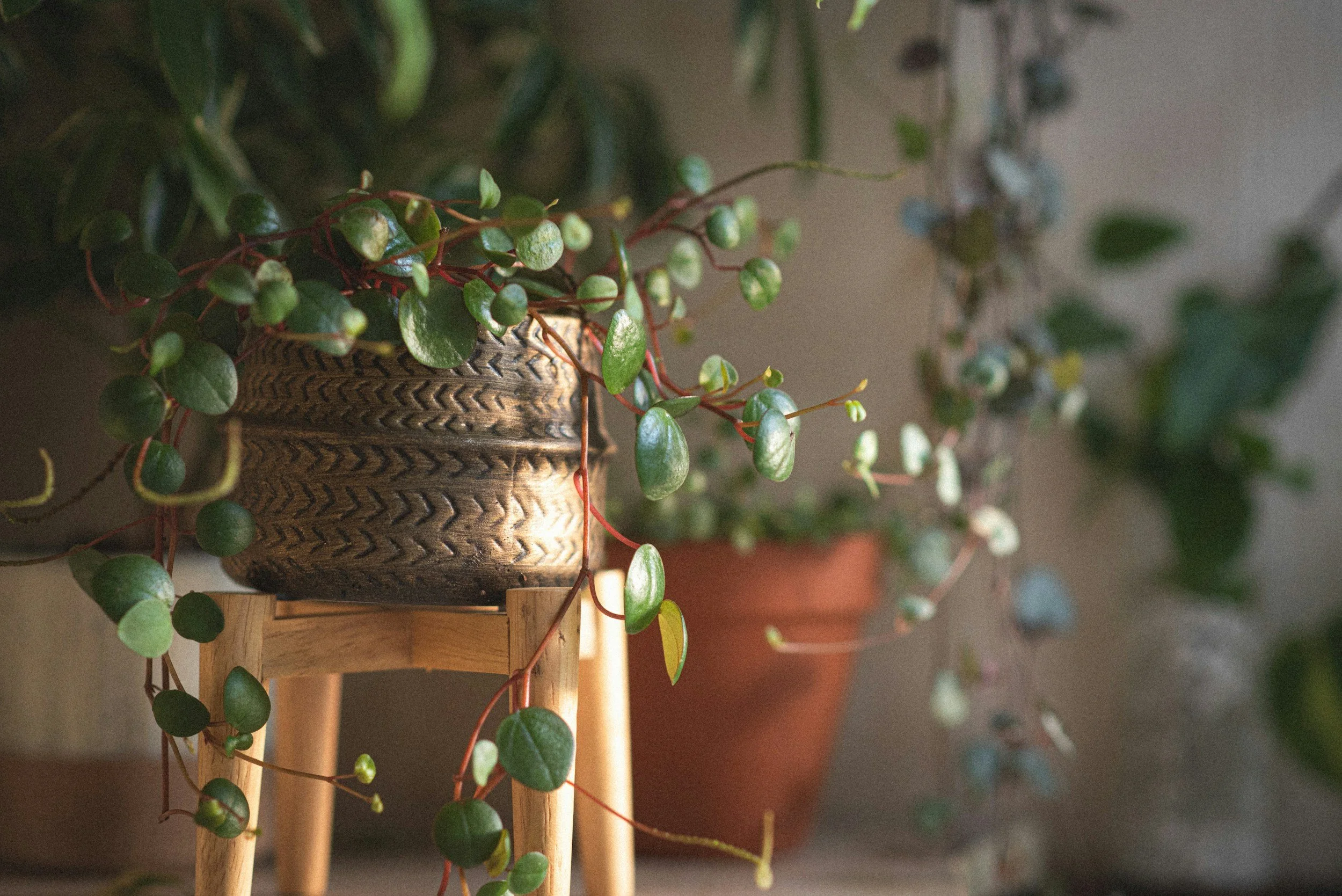
Biochar for Houseplants
Create Healthier Potting Soil for Happy, Thriving Houseplants
When we think about healthy houseplants, we tend to look at what’s happening above the pot: new leaves, strong stems and healthy growth.
But everything depends on what’s happening underneath.
A houseplant has to find all the water, nutrients and root space it needs within the relatively small amount of growing medium inside its pot. Unlike a plant in the garden, its roots can’t simply travel further in search of better conditions.
That makes the quality of your potting mix particularly important.
Adding a small amount of biochar can help create a more resilient, biologically interesting and long-lasting growing environment around your houseplant’s roots.
Why Use Biochar for Houseplants?
Help Potting Mix Retain Water
Containers can be surprisingly difficult environments to manage.
Small pots may dry quickly, particularly in warm rooms or sunny windows, while larger pots can develop very different moisture levels between the surface and the bottom.
Biochar has an extremely porous internal structure.
When properly wetted, those pores can interact with water within the growing medium and can help influence its water-holding characteristics.
That doesn’t mean a houseplant containing biochar won’t need watering.
It does mean that biochar can become one part of creating a potting mix that makes better use of the water you provide.
This can be particularly useful for plants growing in relatively free-draining mixtures.
Help Retain Nutrients
Every nutrient available to a houseplant has to come from the relatively small environment contained within its pot.
Some comes from the original potting mix.
Some comes from organic matter.
And some is supplied when you feed the plant.
Biochar itself isn’t a fertiliser.
Instead, its enormous internal and external surface area can interact with nutrient ions and organic compounds within the growing medium.
This can help retain nutrients within the root environment rather than allowing them to move as readily through the pot when you water.
Think of biochar not as plant food, but as part of the infrastructure that helps your potting mix manage water and nutrients.
Create Habitat for Microorganisms
A plant pot might look like a simple container of compost, but biologically active growing media can contain complex communities of microorganisms.
Biochar’s network of tiny pores and surfaces can provide microhabitats in which microorganisms can establish.
This is particularly interesting when biochar is combined with mature compost, worm castings or other biologically active materials.
Rather than thinking about a plant growing in an inert substance, we can start thinking about creating a living root environment.
First Things First: Always Charge Your Biochar
Before using Sweethill Biochar around houseplants, there’s one important rule:
Never use it dry.
Our biochar should be thoroughly wetted and charged before being added to your houseplant potting mix.
There are two reasons.
Firstly, dry biochar is highly porous. Charging allows water, nutrients and organic compounds to begin interacting with those pores and surfaces before they’re placed around your plant’s roots.
Secondly, fine dry biochar can be dusty — particularly undesirable when you’re working indoors.
So:
Dry biochar stays in the bag. Charged biochar goes into the pot.
How to Charge Biochar for Houseplants
You don’t need anything complicated.
Put the amount of biochar you need into a container and thoroughly wet it.
Then add a suitable nutrient source.
For houseplants, you could use:
diluted liquid houseplant feed
worm castings
suitable wormery liquid
mature compost
compost extract
another appropriate nutrient-rich organic solution.
Allow the biochar to soak for at least two hours before use.
Alternatively, mix thoroughly wetted biochar with moist compost or worm castings and allow it to condition there.
The biochar should be thoroughly moist before you bring it anywhere near your plant.
How Much Biochar Should I Use?
With houseplants, more isn’t necessarily better.
Your plant still needs an appropriate potting medium for its particular requirements.
As a straightforward starting point, we suggest around:
5–10% charged biochar by volume
mixed thoroughly through your normal potting mix.
So, for example:
5 litres of potting mix = approximately 250–500 ml of charged biochar.
You can adjust your mixture according to the plant, growing medium and conditions.
The important thing is that biochar is an addition to a good potting mix, not a replacement for it.
How to Use Biochar When Repotting
Repotting is the easiest time to introduce biochar.
First, choose an appropriate potting mix for your plant.
Then:
1. Charge your biochar.
Make sure it is thoroughly moist.
2. Mix it through your potting medium.
Aim for approximately 5–10% biochar as a starting point.
3. Remove your plant from its existing pot.
Check the roots and remove obviously dead or rotten material if necessary.
4. Position the plant in its new pot.
Use your biochar-enriched potting mix to fill around the rootball.
5. Water appropriately.
Then continue caring for the plant according to its individual requirements.
Don't create a thick layer of pure biochar at the bottom of the pot.
And don't pack pure biochar directly around the roots.
Mix it through the growing medium.
The Handful Method for Larger Houseplants
For larger plants, you can make things even simpler.
When repotting, take a small handful of charged biochar and mix it thoroughly through the fresh potting mix surrounding the rootball.
For a very large container, use several handfuls distributed throughout the growing medium.
This is particularly convenient if you don't want to measure precise volumes.
The principle is the same as when planting outdoors:
Put charged biochar where the future roots will grow.
What About Houseplants That Are Already Potted?
If your houseplant is happy, there’s no need to disturb its roots simply to add biochar.
The easiest option is to wait until the plant next needs repotting.
If you particularly want to introduce biochar sooner, you can mix a small amount of finely graded, thoroughly charged biochar with fresh potting compost and use that mixture when top-dressing the plant.
Gently remove a little of the old surface compost if appropriate and replace it with the biochar-enriched mixture.
Avoid digging deeply into the pot and damaging established roots.
Over time, watering and root activity will help integrate the material.
Biochar for Different Types of Houseplant
This is where a little common sense is important.
Houseplants don't all want the same conditions.
A fern adapted to consistently moist woodland conditions has very different requirements from a cactus adapted to dry conditions.
Biochar doesn't change that.
Tropical Foliage Plants
Plants such as monstera, philodendron, pothos and many other tropical foliage plants can be grown in potting mixes containing a modest proportion of charged biochar.
The aim is to create a well-structured growing medium that balances moisture retention with appropriate drainage and aeration.
Ferns and Moisture-Loving Plants
For plants that prefer more consistent moisture, biochar can form part of a moisture-retentive growing mixture.
But it still needs to be combined with a suitable growing medium for that particular plant.
Cacti and Succulents
Be more cautious.
Cacti and succulents generally require excellent drainage and can be damaged by growing conditions that remain excessively wet.
A small amount of biochar may be incorporated into an appropriately free-draining cactus or succulent mixture, but don't assume that because biochar can help retain water, more must be better.
The needs of the plant always come first.
Orchids and Specialist Plants
Some houseplants require specialist growing media rather than conventional potting compost.
Orchids are an obvious example.
If you're growing a plant with very particular substrate requirements, follow specialist advice for that species rather than simply adding biochar according to a general houseplant recipe.
Biochar Doesn't Mean You Can't Overwater
This is important.
Biochar isn't a cure for overwatering.
If a plant is sitting in a pot with poor drainage and is continually watered faster than it can use the moisture, adding biochar won't solve the underlying problem.
Your pots should still have appropriate drainage.
Your growing medium should still suit the plant.
And you should still allow the plant to dry to whatever degree is appropriate between waterings.
Biochar is about improving the growing environment, not overriding the biological requirements of the plant.
Keep Feeding Your Houseplants
Biochar doesn't replace plant food.
Houseplants eventually use the nutrients available within their potting medium and may require supplementary feeding during active growth.
Continue feeding according to the requirements of your plant.
The biochar becomes part of the environment through which those nutrients move and interact.
That's why we particularly like the combination:
Good potting mix + charged biochar + appropriate feeding.
Each has a different role.
What Happens When I Repot Again?
This is one of the particularly interesting things about using biochar.
Biochar isn't "used up" in the same way as many components of potting compost.
Its carbon structure is highly resistant to decomposition.
So when you repot your houseplant again in the future, the biochar you've already added may still be present.
If the old potting mix is healthy and suitable for reuse, that biochar can potentially continue its journey into another growing mixture, compost heap or garden soil.
You're not buying something designed to disappear after a few months.
You're adding a persistent carbon-rich material to your growing system.
A Little Goes a Long Way
Houseplants are also an economical way to use biochar.
At around 5–10% of your potting mixture, you only need relatively small quantities.
A litre of biochar could potentially enrich approximately 10–20 litres of finished growing medium, depending on the proportion you choose to use.
And because biochar persists, that small amount can remain part of your growing system for a very long time.
Why Choose Sweethill Biochar for Your Houseplants?
When you're putting something directly around the roots of plants growing inside your home, we think it's particularly reassuring to know where it came from.
That's one of the things that makes Sweethill Biochar distinctive.
Our biochar is traceable back to our own woodland.
We make our biochar here in Devon from timber arising from the management of our woodland.
Much of that woodland is ancient woodland that was historically planted with commercial conifers.
We're now gradually removing those plantation trees as part of our long-term work to restore a more diverse native woodland ecosystem.
Some of that timber becomes our pure biochar.
So we know:
where the trees grew,
why they were felled,
who made the biochar,
and what we're working to restore in their place.
There is a remarkably short journey between the source of our biochar and the bag that reaches you.
And because we're a small family business, buying our biochar directly supports the work we're doing to care for and restore that woodland.
From Our Woodland to Your Windowsill
A houseplant might be growing in a pot hundreds of miles from our woodland, but there is still a connection between the two.
A tree removed as part of restoring our woodland provides some of the timber from which we make biochar.
We transform that wood through pyrolysis into stable, porous carbon.
You charge a small amount and mix it into your houseplant compost.
Roots grow through it.
Microorganisms interact with it.
And long after the original potting compost begins to break down, much of that carbon can remain.
A little biochar. A long-term investment in the soil around your plants.