
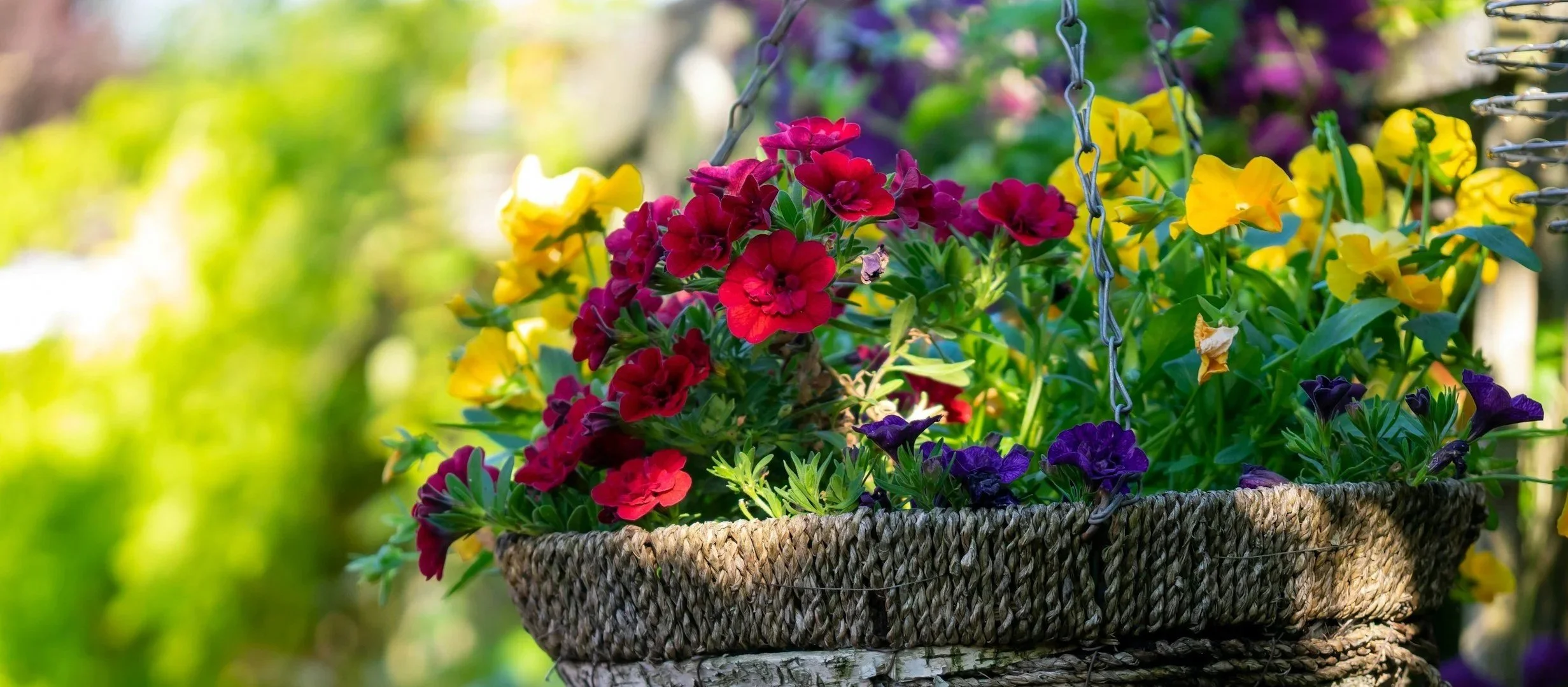
Biochar for Hanging Baskets
Keep Hanging Baskets Healthier, Hydrated and Thriving for Longer.
Hanging baskets can be some of the hardest-working growing environments in the garden.
We fill a relatively small container with compost, pack it with hungry plants and then suspend it in the air, where it is exposed to sun and wind. On hot summer days, baskets can dry astonishingly quickly — sometimes needing watering once or even twice a day.
At the same time, regular watering can wash soluble nutrients through the compost and out of the bottom of the basket.
Biochar can help.
Mixed into your hanging-basket compost before planting, biochar provides a highly porous, carbon-rich structure that can help retain water and nutrients while creating habitat for beneficial microorganisms.
It won't remove the need to water or feed your baskets.
But it can help create a more resilient growing environment in which the water and nutrients you provide are put to better use.
Why Hanging Baskets Dry Out So Quickly
A plant growing in the ground can send roots outwards and downwards in search of moisture.
A hanging basket can't.
Its entire root system is confined within a relatively small amount of growing medium.
The basket is also surrounded by moving air, often exposed to direct sunshine and warmed from several directions. Add thirsty, vigorously flowering plants and the result can be very rapid moisture loss.
This is one reason hanging baskets can look spectacular in June and considerably less happy after a week of hot weather.
Biochar gives us another tool for managing that problem.
Biochar Is Incredibly Porous
Pick up a piece of biochar and it may look like an ordinary piece of charcoal.
Look at it under magnification, however, and it's anything but solid.
Biochar contains a complex network of pores inherited from the cellular structure of the original wood. Water can enter this pore network and interact with the enormous internal surface area of the biochar.
When biochar is mixed throughout a growing medium, it can therefore help influence how water is retained within that mixture.
For a hanging basket, where every litre of growing medium has to work hard, that's particularly useful.
Think of it as adding tiny reservoirs throughout your compost.
The biochar doesn't magically create water.
You still need to water your plants.
But it can help the growing medium retain moisture, potentially making the basket more resilient between waterings.
And It's Not Just About Water
Anyone who grows really impressive hanging baskets knows that watering is only half the battle.
Those masses of flowers require nutrients.
Because baskets are watered so frequently, soluble nutrients can gradually move through the growing medium and drain from the bottom.
Biochar's surfaces can interact with and retain various nutrient ions, helping keep them within the growing system rather than allowing them to be lost as readily.
That's why biochar works particularly well alongside compost and regular feeding.
It isn't a fertiliser.
Instead, think of it as helping create a better environment for the fertiliser and nutrients you're already providing.
Compost Feeds. Biochar Helps Hold.
This distinction is important.
We don't recommend replacing compost with biochar.
Your hanging-basket compost provides organic matter and, depending on the product you're using, nutrients for your plants.
Biochar does something different.
Its porous carbon structure can help with:
Water retention
Helping the growing medium hold moisture between waterings.
Nutrient retention
Helping retain nutrients within the growing medium.
Soil biology
Providing surfaces and pore spaces that microorganisms can inhabit.
Long-lasting structure
Unlike organic matter that gradually decomposes, biochar is highly resistant to breakdown.
So the combination we're interested in is:
Good compost + charged biochar + appropriate feeding
Not one instead of the other.
How to Use Biochar in Hanging Baskets
Fortunately, this is very easy.
Step 1 — Charge Your Biochar First
Never add our biochar dry to your hanging-basket compost.
Before using Sweethill Biochar, thoroughly wet and charge it.
Place your biochar in a bucket or container, add water and ideally include something nutrient-rich such as:
compost tea or compost extract
wormery liquid
a suitable liquid plant feed
or another appropriate nutrient-rich organic solution.
Alternatively, mix thoroughly wetted biochar with moist, mature compost and allow it to condition there before use.
We recommend allowing at least two hours for a simple pre-soak before planting.
The biochar should be thoroughly moist when you use it.
Step 2 — Mix It Through Your Compost
Once charged, mix the biochar evenly through your hanging-basket compost.
Don't create a separate layer of biochar at the bottom.
And don't fill large areas of the basket with pure biochar.
You want lots of small pieces distributed throughout the growing medium, where plant roots can eventually encounter them.
A simple starting mixture
For hanging baskets, try approximately:
5–10% charged biochar by volume
with:
90–95% of your usual good-quality hanging-basket growing medium.
So for 10 litres of growing medium, you could start with approximately:
0.5–1 litre of charged biochar.
Mix everything thoroughly before filling your basket.
There's rarely any advantage in thinking that more biochar must automatically be better. You're creating a balanced growing medium, not trying to grow plants in biochar alone.
Step 3 — Plant Normally
Once the biochar is thoroughly mixed through your compost, plant your basket exactly as you normally would.
Trailing petunias, lobelia, begonias, fuchsias, geraniums, calibrachoa, bacopa and other popular basket plants can all be planted into a biochar-enriched growing medium.
Around each rootball, you can also mix a small additional amount of charged biochar with the surrounding compost as you plant.
Don't pack pure biochar directly against the roots.
Mix it through the compost.
Step 4 — Water Thoroughly
After planting, give the entire basket a thorough watering.
Then continue watering according to the needs of your plants and the weather.
Biochar does not make a hanging basket drought-proof.
You'll still need to check your baskets regularly during hot weather.
What you're trying to create is a growing medium that is better able to retain and manage the moisture you provide.
Step 5 — Keep Feeding Your Plants
Biochar doesn't replace plant food.
This is particularly important with hanging baskets.
A basket covered in flowers is using considerable amounts of nutrients, so continue your normal feeding regime according to the plants you're growing and the fertiliser you're using.
The advantage of biochar is not that you can stop feeding.
It's that you're adding a material capable of interacting with nutrients within the growing medium while providing long-lasting porous structure.
What About Existing Hanging Baskets?
Already planted your baskets?
You can still use biochar.
Rather than disturbing established roots, take a small amount of thoroughly charged biochar and mix it with compost.
Carefully make several small openings in the surface of the basket, away from the main stems, and work modest amounts of the biochar-compost mixture into the upper growing medium.
Water thoroughly afterwards.
Don't try to excavate the basket or disturb established root systems simply to add biochar.
If the basket is already flourishing, you can also simply wait until you're preparing your next baskets and incorporate biochar properly from the beginning.
What Happens at the End of Summer?
Here's another advantage.
At the end of the season, don't throw that biochar-enriched compost away.
Biochar is extremely persistent.
Once you've removed your annual plants, the spent growing medium can be added to:
your compost heap
vegetable beds
raised beds
flower borders
around trees and shrubs
or other garden soils.
The compost may gradually decompose.
The biochar remains.
So something you originally bought to help your summer hanging baskets can ultimately become part of your garden soil.
That's very different from many products designed for a single growing season.
Particularly Useful During Hot, Dry Summers
Biochar becomes especially interesting for hanging baskets when we think about increasingly unpredictable summer weather.
A few days of intense sunshine can put container plants under considerable stress.
And hanging baskets are particularly vulnerable because they have such a small reservoir of growing medium.
Biochar shouldn't be marketed as a substitute for sensible watering — it isn't.
But improving the water-holding characteristics of your growing medium can become one useful part of making container growing more resilient to dry periods.
For anyone who has returned home on a hot afternoon to find a beautiful hanging basket suddenly looking decidedly unhappy, that's an appealing prospect.
A Small Amount Can Go a Long Way
Hanging baskets are also a great introduction to biochar because you don't need very much.
If you're using around 5–10% by volume, a relatively small quantity of biochar can enrich several baskets.
And because biochar can ultimately be transferred into your garden soil at the end of the season, it isn't simply being used up.
You're gradually moving stable carbon from:
our woodland → your hanging baskets → your compost → your garden soil.
Why Use Sweethill Biochar?
If you're adding something to the compost around your plants, we think you should know where it came from.
Our biochar has something very important to us:
Sweethill Biochar is made here in Devon from timber arising from the management of our own woodland.
Much of our woodland is ancient woodland that was historically planted with commercial conifers. We're gradually removing those plantation trees as part of our long-term project to restore a diverse native woodland ecosystem.
Some of that timber is transformed into our pure biochar.
So we can tell you:
where the wood grew,
why the trees were felled,
who made the biochar,
and what we're working to restore in their place.
And because we're a small family business, your purchase directly helps support that restoration work.
So your hanging baskets don't just have the opportunity to benefit from biochar.
The woodland that produced it benefits too.
From our woods, through our kilns, into your baskets — and eventually back into living soil.